Wednesday, August 18, 2010

Tamarack Wellness Center Begs Support

Local nonprofit Tamarack Wellness Center has fallen into deep financial crisis with the loss of a $60,000 donor. The center itself—which offers swimming, yoga and massage therapy as a means of promoting good health—relies exclusively upon donations and fees to keep itself functional. Without government finance, the loss of a $60,000 donor could be detrimental to the center’s quality of service unless said amount is raised by September 1st.

Donor and executive director for the Tamarack Wellness Center, Sue Sherman, will take her leave from the company at the end of this month, thus cutting her donation chord and resulting in the urgent revenue shortage. She encourages the public to donate so that Tamarack can “broaden its base of support.”

She says: “It’s time for the Lane County community to do their part” in a cry for help to the citizens of Eugene—and surrounding areas—to save the company by making tax deductible donations.


As of now, the company has raised $15,000, and so find themselves with 75% of next month’s finances left to gather. Board members at Tamarack seem to be handling the stress of the situation well; Ann Cole, board chair, says: “We are confident we can raise the support we need to keep Tamarack alive.”

Ultimately the irony here lies with Sue Sherman’s reason for leaving. She says: “The difficult economic times have contributed to my decision to make this change,” which, understandable as it is, only appears to have left the company with further financial problems.

While the recession has hit everything hard in Oregon, nonprofits seem to be taking the brunt with fewer willing donors to support their services. Tamarack Wellness Center falls unhappily into that category with their founder and major donor falling prey to the economic crisis. For more information on the center, or to donate, see www.tamarackwellness.org

Friday, August 6, 2010

A Belated Review for Crystal Castles (II)

After great success with their first eponymous album, Crystal Castles have become an entity separated entirely from other modern electronic-thrash artists through efficient use of 8-bit technology and raw production techniques. Back in April of this year, I was informed that digital copies of their new album had become available and I jumped at the chance. After fifty minutes of listening however, I was disappointed to find myself feeling strangely empty.


Despite the usual Lo-Fi chaos that I personally see as the essence of the Ontario duo, the album is, in many ways, not as compelling as the first. There is undoubtedly less screaming, which I felt to be the first release’s downfall, but the album’s successes are far outweighed by an apparent lack of creativity in all other facets; the riffs, lyrics, beats and even the production seem to missing something. To put it more clearly, it seems as though the beloved duo are trying too hard to fit the expectations of listeners. In this they have lost the touch of simplicity that is the essence of true 8-bit thrash.

This is not to imply that the album isn’t at all worth listening to. In fact I would certainly recommend it to somebody looking for a wholesome electronica experience. Crystal Castles (II) is undoubtedly a record that can be enjoyed for its variety. That is to say (and this may seem completely out of place among the comments above), the duo have achieved a state in music that The Velvet Underground & Nico reached some forty odd years ago; the album is noisy, sloppy and at times belligerent, but it somehow still maintains the power to send the listener into a drool filled stupor with its dreaminess.
So not all bad I suppose. Maybe I was nit picking before. Who cares? I just came to thrash.

Thursday, August 5, 2010

Wildlife Services: A Vicious Cycle (Briefs Version)

The recent permits to kill Oregon’s small wolf population issued to the USDA’s Wildlife Services division have brought that controversial government agency into the spotlight. Predator advocates such as Eugene’s Predator Defense call for non-lethal predator control, such as the recently funded range rider program, rather than shooting or poisoning wolves and other predators.

A $15,000 U.S. Fish and Wildlife Service grant (USFWS is a separate agency from Wildlife Services) will reimburse livestock producers who pay for a range rider to patrol cattle grazing in areas of the Imnaha wolf pack this summer. The Imnaha pack, which currently has a litter of puppies, is said to have attacked and killed livestock earlier this summer. USFWS says that range riders have been shown to help reduce livestock losses to wolves in other states.

George Wuerthner, a longtime researcher of Wildlife Services, says that general consensus among those who disagree with the policies of Wildlife Services is that information readily available and advertised to the public is quite different from the reality found beneath the surface. For example, he says, the extermination of rabid raccoons is advertised as a solution that Wildlife Services provides, and the public rarely disapproves of this activity since rabies is so dangerous. However, by advertising such services, the indiscriminate killing of wolves, cougars, bears and coyotes are thrown out of the limelight, according to Wuerthner.

Critics say that despite its attempts to protect the livestock industry, Wildlife Services has seemingly worsened the problem. Wuerthner, staff ecologist for Predator Defense, says: “Indiscriminately killing predators skews the age of a population over time … leaving a higher percentage of young, inexperienced predators that are far more likely to target livestock.”

Wuerthner explains what he calls a vicious cycle created by Wildlife Services: A livestock owner calls in a troublesome predator, several animals are killed (among them a large population of older, more experienced hunters) and inexperienced hunters are left to once again target livestock. After this, the cycle repeats.

He says that part of the reason that this cycle exists is that livestock owners often have no incentive to properly protect their animals. “In Chile, the farmers take protective measures like cattle sheds and corral fences to protect their livestock because there are laws against killing predators,” Wuerthner, who recently returned from Chile, says. “In the Northwest there are no laws in place, and so it’s easier just to call in Wildlife Services.”

Wuerthner cites the statistics that say in 2007 Wildlife Services spent upwards of a $100 million in order to control predatory attacks. By the time the year was over, Wildlife Services had become responsible for more than 100,000 animal deaths — coyotes, cougars, cats and dogs among them.

Statistically, predator attacks play a far smaller part in the death of livestock than disease, poisonous plants and injury, but predators are treated differently because, he says, you can’t shoot a disease. — Andy Valentine

[EW 8/5]
Also Scope: Ben Fogelson's Cover Story, HERE

The Parson Red Heads Catch The Worm

Since the release of their debut LP King Giraffe, the Parson Red Heads have found themselves streaking faster and faster toward widespread recognition and success. Being natives of Eugene, they have no qualms with tickling our Oregonian fancies, but their 2010 tour finds them kicking up beautiful, Croce-esque dirt from Chicago to Santa Cruz. Along the way, the group will offer a tour-only, four track EP, Early Birds, which contains three re-recorded versions of old Red Heads songs (including “Choose”), as well as the new “Never Ending Road,” which allows the group’s consistent songwriting talent to shine through.


Early Birds essentially contains more of the beloved, upbeat folk-pop that has served as a staple of the Red Heads sound over the years — and all ye who enter here in search of a folkier Neil Young, Fairport Convention or Byrds influence, do not be disheartened; there is great beauty and poise to be found in the noodles and harmonies of the EP as well as a finely tuned sense of lyricism.

Live Red Heads performances have been known to turn the original three-person group into a gigantic, 14-musician collective that still keeps a tight-knit performance going. Most shows exhibit a mellow, smile heavy atmosphere, interrupted only by the occasional psychedelic pedal fuck-around. In short: the perfect music for a chilled out night in the band’s hometown. The Parson Red Heads and Cotton Jones play at 9 pm Thursday, Aug. 12, at Sam Bond’s Garage. 21+. $5. — Andy Valentine

[From the 8/5 Issue of the Eugene Weekly]
Also Scope: Rick Levin's T-Model Ford Write Up, 3rd down, http://www.eugeneweekly.com/2010/08/05/music2.html

Wednesday, August 4, 2010

Wildlife Services: A Vicious Cycle

In 2007, Wildlife Services spent upwards of a $100 million in order to control predatory attacks. By the time the year was over, Wildlife Services had become responsible for over 100,000 animal deaths—coyotes, cougars, cats and dogs among them.

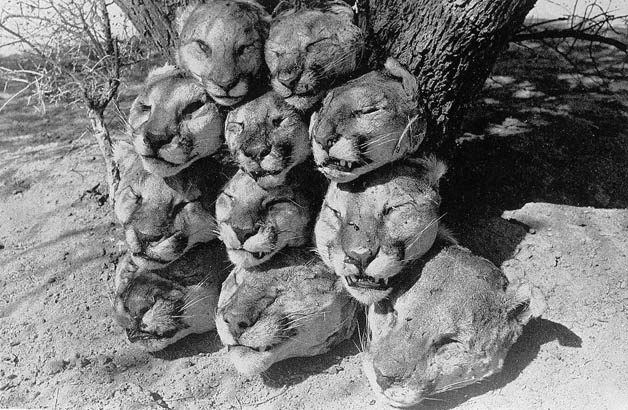
Every year livestock and cattle owners across the Northwest still call in the government’s Wildlife Services program in order to deal with predators that threaten their animals. For some, Wildlife Services seems like an excellent source to turn to when no other means of protection is available. Many others, however, see Wildlife Services as a nuisance. The general consensus among those who disagree with the policies of Wildlife Services is that the information readily available and advertised to the public is quite different to the reality found beneath the surface. For example, the extermination of rabid raccoons is advertised as a solution that Wildlife Services provides, and the public rarely disapproves of this activity due to the dangerous nature of rabies. However, by advertising such services, other happenings such as the indiscriminate killing of wolves, cougars, bears and coyote are swiftly thrown out of the limelight.


Photo: Cougar heads killed by Wildlife Services - predatordefense.org

Despite their attempts to protect the livestock industry, Wildlife Services has seemingly worsened the problem: Long time researcher of Wildlife Services, George Wuerthner, says: “Indiscriminately killing predators skews the age of a population over time…leaving a higher percentage of young, inexperienced predators that are far more likely to target livestock.” In this, Wuerthner explains the beginnings of a vicious cycle created by Wildlife Services: A livestock owner calls in a troublesome predator, several animals are killed (among them a large population of older, more experienced hunters) and inexperienced hunters are left to once again target livestock. After this, the cycle repeats.

Part of the reason that this cycle exists is due to the fact that there are no hunting laws in Oregon and so farmers and livestock owners often have no incentive to properly protect their animals. “In Chile, the farmers take protective measures like cattle sheds and corral fences to protect their livestock because there are laws against killing predators,” says Wuerthner, who recently returned from Chile. “In the Northwest there are no laws in place and so it’s easier just to call in Wildlife Services.”

Statistically, predator attacks play a far smaller part in the death of livestock than disease, poisonous plants and injury, but predators are treated differently because, well, you can’t shoot a disease. Death happens, but hunting and killing predators indiscriminately solves nothing—it just worsens the problem.

For more Information: http://www.predatordefense.org/USDA.htm

Thursday, July 29, 2010

Take ‘em or Leave ‘em

It’s summer again, and everybody is ready to throw their mundane lives aside for some time out. For many, this break takes the form of a weekend camping trip to an overly commercialized — but nevertheless pretty — hosted campground; for others, ridiculous tourist traps like California and Cancun seem to be the only options. But if everybody and their dog decide to go on vacation, what actually happens to the dogs? What about the cats, birds, iguanas and all the other weird creatures that people like to detain and keep as friends? When we humans decide to spend a few days throwing all sorts of money into relaxation, what exactly are we to do with our pets?
Many Eugene pet owners seem to choose the outdoorsy options (camping, backpacking, etc.) because these are pet friendly ways to take time and relax. You can bring your pooch camping most places in Oregon, but national parks such as Crater Lake have restrictions on pets and do not allow them on trails.

For those who are not the outdoor type (but for some reason feel that bringing their pet along on vacation is an absolute must), there are an abundance of Oregon establishments that cater to the canine and other furry clientele. This ranges from inns and hotels to vacation rentals and resorts. If these places don’t cater to pets, one response that has worked for some is stuffing your little friends into a backpack and sneaking ’em in Trojan-horse style. Disclaimer one: This may not work with small yappy dogs. Disclaimer two: We’re not suggesting you do this, just that it happens sometimes.


(Photo: Mandie Stuhan, Lucky Dog)

Now, for those who want to venture far from home, attachment to these cute little life forms tends to pose a larger problem. Paying extra to have your dog locked in a cage for four hours while you fly across the country sounds awful, not to mention the fact that you’re locking up your precious poodly-kins. But here’s the good part: Pets, as much as we sometimes want them to be, are not children. Eugene is littered (pun intended) with cat and dog daycares and boarding kennels, so don’t rule them out as a possibility. This is not to say we should ditch our pets, but rather to weigh the pros and cons of bringing them long distances to crowded vacation spots.

One of the coolest options open to Lane County dog lovers who want to leave town but don’t want their beasties to languish without the benefits of the great outdoors is the Canine Campout provided by the highly certified Mandie Stuhan, owner of Lucky Dog. The campout basically involves your dog living a fun and healthy outdoor lifestyle at the coast or out hiking for a few days. They can “run on the beach, have fun and basically just chill,” says Stuhan.

So take ’em or leave ’em, the choice is yours.

Talk to Lucky Dog about their Canine Campout at
744-BARK


(In the 7/29 issue of EW)

Friday, July 2, 2010

Young Homeless In Eugene: Cover Story

Tim, age 20, Radcliffe, Ky.

“My entire family has been made up of criminals, addicts, alcoholics and car mechanics,” Tim says. He’s been homeless for about two months, he says, and lives on the doorstep outside of John Henry’s. He earned his GED from an adult education center and recently got a job at the Wendy’s on Franklin Boulevard.
He left the South because, “Kentucky seemed bland, you know? I just wanted to see the world for what it was.”
“I want to be a carnie; it’s my life dream to own a traveling circus.”


(Eugene Weekly 7/1 issue)

Jesus, age 16, Eugene
He calls himself Jesus because, “I was on mushrooms and decided that, not unlike Jesus, I see everything for what it is.”
Jesus says he was raised by a normal family in the Whiteaker area and was homeschooled til about halfway through high school. He’s been homeless since he was 13. Jesus used to live in a traditional homeless shelter, now lives on the doorsteps of businesses in downtown Eugene.
He says that nobody ever gives homeless people — much less homeless kids — the time of day to hear their stories. “Living outside of society, trying to keep equilibrium with everything around.”
He manages to make an average of $10 in an hour (on a good day) by asking for change.

(From the Cover Story: Eugene Weekly 7/1)
http://www.eugeneweekly.com/2010/07/01/index.html